

Can You Just Spot-Clean Rodent Insulation, or Does Your Greenbrier Crawlspace Need Full Replacement?
August 10, 2026
It's a completely fair question, and it's the one we get most often on the phone: the nesting was in one corner, the rest of the crawl space looks fine, so why replace all of it?
The answer isn't a sales position. It comes down to how rodent contamination physically behaves in fiberglass — and there are situations where a partial scope genuinely is the right call. Here's how to tell the difference in a Greenbrier (23320) or Great Bridge (23320, 23322) home.
What Contaminated Crawl-Space Insulation Can Look Like
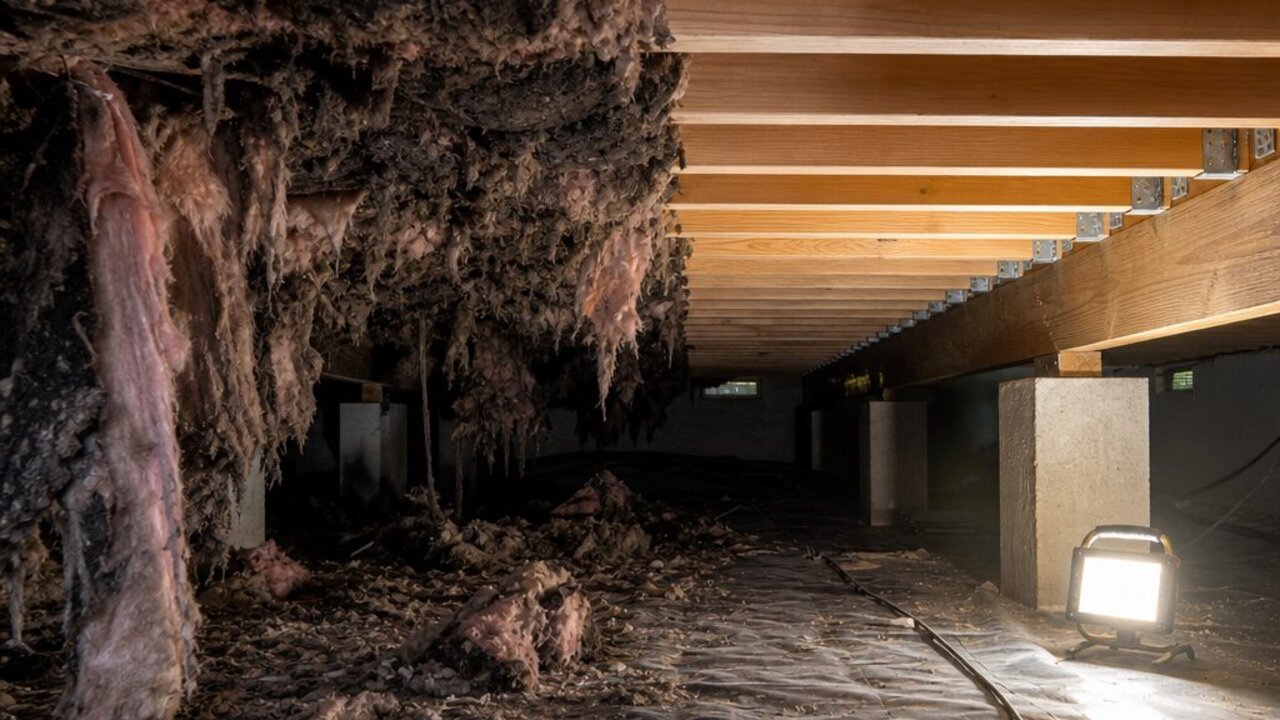
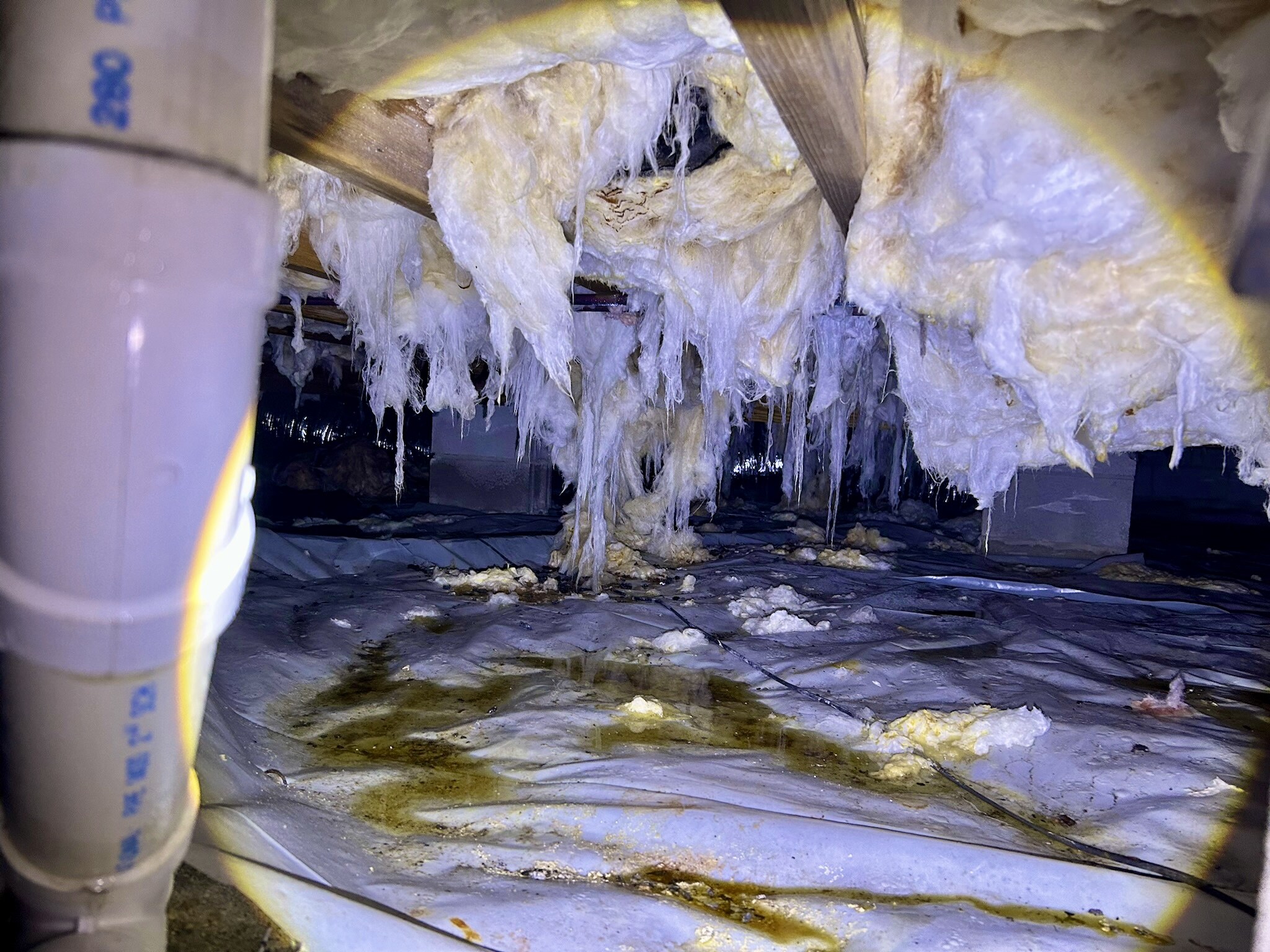
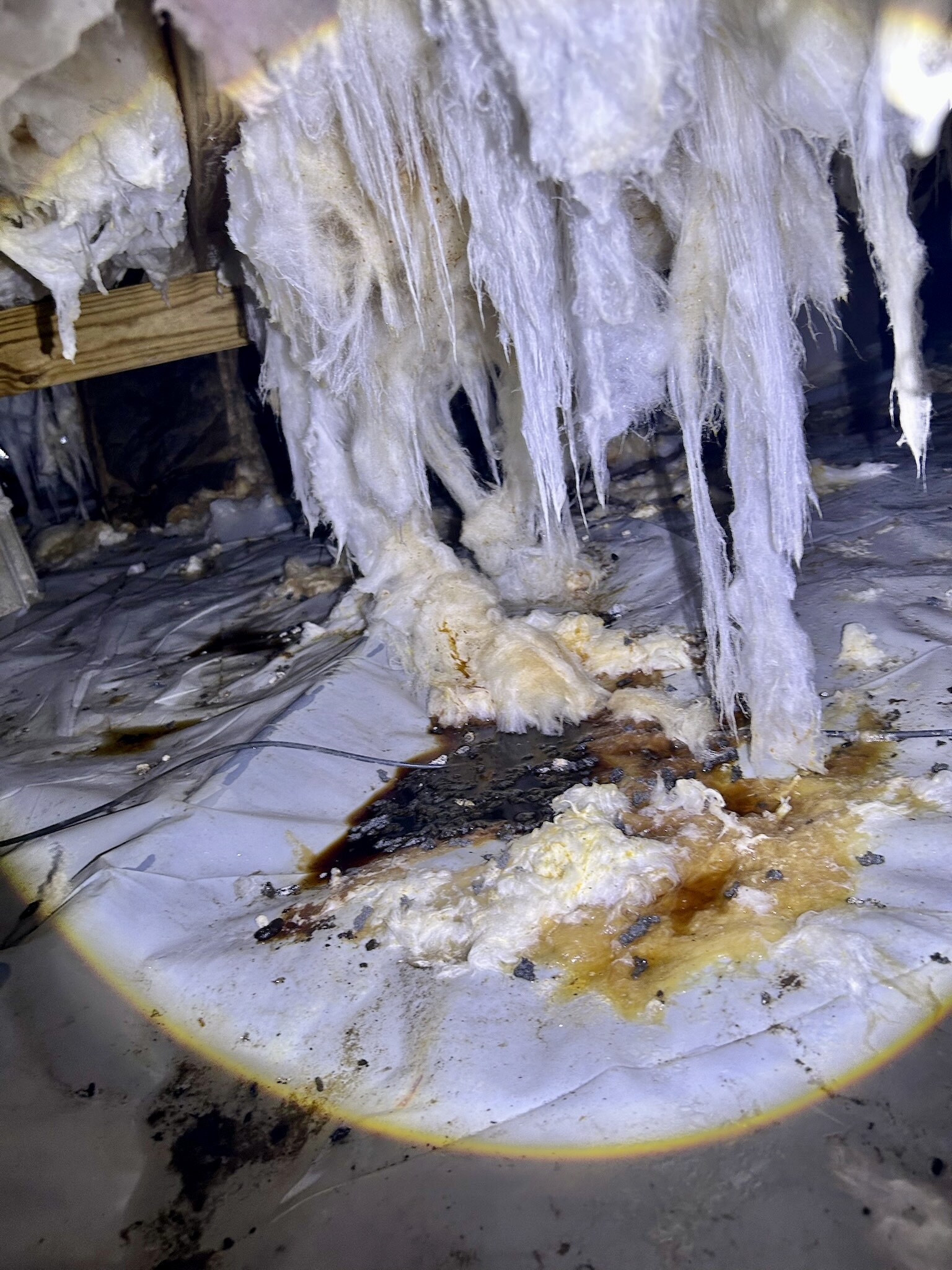
These photos from a recent crawl-space job show why contaminated insulation is not treated like a simple spot-cleaning project. Pulled-down fiberglass can carry droppings, urine staining, nesting material, and odor into the joist bays and onto the vapor barrier below. When contamination is widespread, the practical sequence is to correct the source, remove and dispose of the affected insulation, sanitize the exposed framing and subfloor, address the vapor barrier and moisture conditions, and then install new supported subfloor insulation.
What Spot-Cleaning Leaves Behind
Urine has already spread past what you can see.This is the core problem. Rodent urine wicks laterally through fiberglass batts and along the kraft facing well beyond the nest, and once dry it leaves no visible mark. There is no way to look at a batt and know where the contamination stops. Pulling the stained sections means pulling the sections you can identify, not the sections that are affected.
Scent marking stays in place.Rodents navigate by scent trails. Material left in the crawl space keeps carrying that signal, which is why homes that get a partial cleanup so often report renewed activity the following season even after the entry points were sealed. You've removed the nest and left the invitation.
Kraft facing and vapor retarder are compromised.Most Chesapeake crawl space batts are kraft-faced, installed between the floor joists. Once rodents have torn the facing to nest behind it, the facing no longer functions as a vapor retarder — and saturated paper facing in a humid crawl space is an ideal substrate for mold growth. Patching around it doesn't restore the assembly.
Compressed batts don't recover.Fiberglass insulates by trapping air. Compressed or matted material has lost that loft permanently, so leaving it in place means keeping a section of crawl space that's insulated on paper and not in practice.
The soil and vapor barrier underneath are usually part of it.In crawl spaces, rodent waste doesn't stay in the joist bays. It falls. If the barrier below is torn — and in a 1970s or 80s Chesapeake crawl space it usually is — waste has reached the soil, and no amount of work on the insulation above addresses it.
When a Partial Scope Is Actually Reasonable
We'd rather tell you the truth than sell you a bigger job. Partial replacement can make sense when:
The activity was caught early — a single season or less — and confined to a clearly bounded area near a known entry point. Batt insulation in a crawl space with distinct joist bays contains spread better than blown-in material in an open attic. There's a physical barrier, such as a foundation wall dividing an addition from the original footprint, between the affected zone and the rest of the space. And the vapor barrier below the affected area is intact.
Even then, the affected zone gets removed generously past the visible boundary, the exposed area is HEPA-vacuumed and treated with an antimicrobial, and the barrier is replaced beneath it. What we won't do is pull three bad batts, staple in three new ones, and call the crawl space clean.
Why Greenbrier and Great Bridge Crawl Spaces Are Their Own Situation
Greenbrieris largely a 1970s through 1990s buildout around the Greenbrier Parkway corridor and Indian River, on flat land with a high water table. Crawl spaces here run damp much of the year, and damp crawl spaces attract rodents looking for water as much as shelter. Damp also means that once waste is present, odor and microbial growth develop faster than they would in a dry space.
Great Bridgemixes much older housing stock near the historic battlefield and the Albemarle & Chesapeake Canal lock with newer subdivisions further out. The older homes tend to have brick pier foundations, dirt floors, and vent openings that have been enlarged by decades of settling — straightforward rodent access. The newer ones have tighter construction but the same water table.
In both neighborhoods, the crawl space moisture picture and the rodent picture are the same conversation. Fixing one without the other is a temporary result.
⚠ Don't Assess It Yourself
The CDC identifies hantavirus as a serious risk associated with rodent droppings, urine, and nesting material in enclosed spaces, transmitted by breathing airborne particles rather than by contact. Confirmed Hantavirus Pulmonary Syndrome cases carry an approximate38%mortality rate, and the CDC additionally lists leptospirosis, salmonella, and lymphocytic choriomeningitis among diseases associated with rodents. A crawl space is a small, poorly ventilated enclosure — among the worst places to disturb dried waste without a respirator.CDC guidance on hantavirus prevention.
The Full Sequence
Exclusion first — Universal Pest & Termite handlesrodent trapping and entry-point sealingand theirChesapeake teamcovers vent screens, rim joist gaps, and foundation penetrations. Then removal and disposal of contaminated batts and barrier, HEPA vacuuming, antimicrobial treatment of the joists and subfloor, a new 20-mil vapor barrier where the old one has failed, and new insulation.
If the moisture problem underneath is chronic, that's worth solving in the same visit rather than repeating the whole exercise in three years — seecrawl space encapsulation in Chesapeake.
Neighborhood pages:Greenbrier crawl space insulation,Great Bridge crawl space insulation,Greenbrier services, andGreat Bridge services. Citywide scope is onChesapeake insulation removal, and we've written more onrodent-contaminated insulation in Greenbrier.
Frequently Asked Questions
Can rodent-contaminated insulation be disinfected instead of removed?
Surfaces can be disinfected. Insulation can't, in any meaningful sense — a fogged antimicrobial coats the outside of a batt and doesn't penetrate to the urine that has wicked through the interior of the fiber mass and into the facing. That's why the sequence is remove first, then treat the exposed framing and subfloor. Disinfectant is for the structure, not for the material coming out.
Still finding droppings after the traps went quiet? Book a free attic inspection
How much cheaper is spot-cleaning than full replacement?
Less than most people expect. The bulk of the cost is mobilization, containment setup, and labor in a confined space — all of which you pay whether the crew pulls a third of the crawl space or all of it. The material and disposal difference on a partial job is real but modest, and it's frequently erased by having to come back. We'll price both scopes at inspection so you can see the actual gap for your home.
Want to see how contaminated material actually comes out? How insulation removal works
The smell is gone. Doesn't that mean the contamination is gone?
No. Odor intensity tracks humidity and temperature more than it tracks contamination — dried waste in a cool, dry period smells like very little, and the same material will smell strongly again in August. Pathogens and scent-marking compounds don't disappear when the odor drops below your detection threshold. Absence of smell is not evidence of a clean crawl space.
Wondering what Pest Guard adds on the reinstall? About Pest Guard Insulation™
Free Crawl Space Inspection in Chesapeake
We serve Greenbrier, Great Bridge, and all ofChesapeake. We'll map the contamination, check the barrier and moisture levels, and price both a partial and a full scope so you can decide with real numbers.
Ready for a Free Estimate?
Universal Insulation Doctor serves all of Hampton Roads. Call now or fill out our quick form — we'll get back to you same day.
Have a Question?
Can't find the answer you're looking for? Our team is always happy to help. Give us a call or fill out the form for a free no-obligation consultation.
(757) 962-0340