

Rodent-Contaminated Insulation in Greenbrier, Chesapeake: What Homeowners Need to Know
July 5, 2026
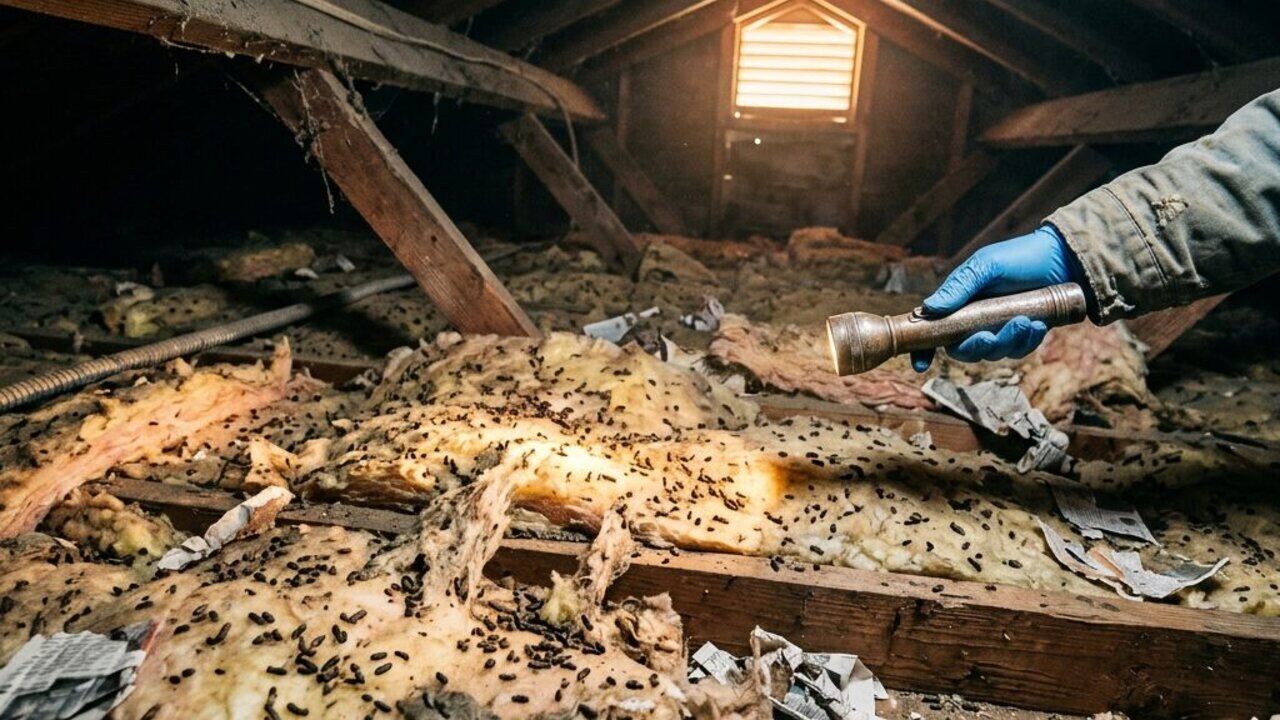
Greenbrier (Chesapeake, VA 23320) is one of central Chesapeake's most built-out residential areas — a mix of subdivisions that went up in the 1970s, 1980s, and 1990s alongside newer infill construction, all connected by the commercial corridor anchored by the Greenbrier area's retail and office development. It's a neighborhood where the trees planted at original construction have now had 30 to 50 years to grow into full canopy, providing the kind of aerial access routes to rooflines that mice and roof rats use regularly.
Homes in Greenbrier tend to have attic access via pull-down stairs — the standard construction of that era — and HVAC systems that run their ductwork through the attic space. Both factors matter when rodents get in: the attic insulation is accessible and the duct system is at risk. If you've had rodent activity confirmed in your Greenbrier attic, the insulation question is not a small one.
Why Greenbrier Homes See Rodent Pressure
The 1970s through 1990s construction period that defines most of Greenbrier's housing stock introduced some specific vulnerabilities. Soffit and fascia systems from this era were often installed with gaps that weren't apparent until the wood began to weather. Vinyl soffit panels, common in 1980s construction, eventually develop cracks and pull away from their fasteners. The gable vents that were standard on homes of this generation were frequently screened with lightweight mesh that deteriorates within a decade of installation.
The mature trees that now canopy much of Greenbrier's residential streets have branches that regularly contact or overhang rooflines — particularly in the established subdivisions where original construction landscaping has had decades to grow. Roof rats in particular are climbers that use overhanging branches as a direct travel route from the ground to your roofline without touching the siding.
Once inside the attic, rodents find everything they need: thermal protection, quiet darkness, and insulation that provides both nesting material and territory to mark. An infestation can establish itself and run for months before a homeowner notices anything definitive.
Signs That Rodents Have Been in Your Attic
Scratching or scurrying sounds after dark.Rodents are nocturnal. Sounds of movement in ceiling spaces — especially sounds that suggest travel from one area to another — heard at night are a reliable indicator of active infestation.
Ammonia-like odor near registers or ceiling fixtures.Rodent urine saturating insulation produces a sharp ammonia smell that can work its way downward through the stack effect into living areas. An odor coming from HVAC registers is particularly worth investigating — it may indicate the duct system has been compromised as well.
Droppings at or near the attic hatch.Small, dark, rice-grain-sized droppings (mice) or raisin-sized droppings (rats) near the attic access are definitive evidence of activity.
Disturbed or compressed insulation.Nesting rodents burrow into and flatten insulation. Sections that look tunneled through, shredded, or significantly matted down are nesting zones and should be treated as contaminated.
Entry points sealed by a pest inspector.If a pest professional has confirmed and sealed entry points at your roofline, the insulation inside should be considered contaminated regardless of visible damage extent.
The Health Risk Shouldn't Be Underestimated
⚠ Hantavirus Warning
The CDC identifies hantavirus as a serious risk associated with rodent droppings, urine, and nesting material in enclosed spaces like attics. Hantavirus Pulmonary Syndrome (HPS) is transmitted by breathing in airborne particles — dust disturbed from dried rodent droppings or urine — not by direct contact with a rodent. Confirmed HPS cases carry an approximate mortality rate of38%. Greenbrier homeowners should not disturb attic insulation suspected of rodent contamination without proper respiratory protection. Professional removal with HEPA equipment is the safe approach.See CDC guidance on hantavirus prevention.
Beyond hantavirus, rodent contamination in attic insulation can include leptospirosis, salmonella, and lymphocytic choriomeningitis (LCM). The stack effect in your home continuously draws air from the attic space downward into living areas through wall cavities and ceiling penetrations. Contaminated insulation that sits undisturbed is still a slow exposure risk — and any disturbance, including an HVAC system pulling from attic-adjacent spaces, can move contaminated particles into your home's air supply.
Why Full Replacement Is the Only Adequate Response
Spot-cleaning or partial replacement isn't sufficient, and here's why it's not a judgment call. Rodent urine soaks into fiberglass insulation far beyond any visible nesting site — the contamination spreads invisibly and there is no reliable way to identify its full extent by visual inspection alone. Removing only the sections with obvious damage guarantees that contaminated material remains in the attic.
Full remediation also requires access to the attic deck for HEPA vacuuming of accumulated debris and antimicrobial treatment before any new insulation is installed. These steps — which prevent both health risk from residual contamination and recurrence from improperly prepared surfaces — cannot be performed with existing insulation in place. Universal Insulation Doctor'sinsulation removal processincludes full extraction, HEPA vacuuming, antimicrobial sanitizing treatment, and entry point documentation as a complete sequence.
Pest Guard Insulation™: Protection After Remediation
After contaminated insulation is removed and the attic is sanitized and sealed, Universal Insulation Doctor can installPest Guard Insulation™ for Chesapeake homes. It is a borate-treated fiberglass option described as intended to deter certain insects. Ask for the current product label to confirm listed insects, approved use, and treatment duration. It is not a rodent deterrent or a replacement for exclusion.
Sealing Entry Points Before Re-Insulation
Installing new insulation into an attic that still has open entry points is a setup for an immediate repeat infestation. Every gap — at soffits, fascia joints, pipe penetrations, gable vents, and ridge cap — must be sealed before new material goes in. Universal Insulation Doctor coordinates directly with our sister company, Universal Pest & Termite, whose team specializes in rodent exclusion work throughout Chesapeake. You can read more about their approach torodents in Chesapeake atticson their site. Coordinating pest control and insulation replacement as a single project means nothing falls through the gap between trades.
Air Duct Cleaning: The Critical Next Step
In Greenbrier homes where HVAC ductwork runs through the attic, a rodent infestation in the attic means the duct system must be inspected and cleaned before remediation is complete. Rodents travel along and through ductwork, nesting in flex duct connections and depositing droppings and urine that your HVAC then distributes throughout every room on every cycle. Installing new attic insulation without addressing the duct system leaves contaminated air circulating through your home.
Universal Duct Cleaning provides professionalduct cleaning services in Chesapeakeand coordinates directly with Universal Insulation Doctor so both steps are completed as a single managed remediation project. The correct sequence — remove contaminated insulation, seal entry points, clean and sanitize ducts, install new insulation — is the only approach that fully resolves the problem.
Frequently Asked Questions
How do I know if my attic insulation needs to be fully replaced after a rodent infestation?
If a pest inspector has confirmed active or past rodent activity in your attic — through droppings, entry point evidence, or visual nesting — the safest and most complete approach is full replacement. Rodent urine contaminates insulation across a wide, invisible radius from any nesting site. Spot-removal cannot reliably capture the full extent of contamination. Universal Insulation Doctor's free attic inspection will assess your specific situation and provide a written estimate for full remediation.
Still finding droppings after the traps went quiet? Book a free attic inspection
Is it safe to go into my attic to check the damage myself?
It is not recommended without proper respiratory protection. The CDC warns that hantavirus — a potentially fatal respiratory illness — is transmitted by breathing in airborne particles from dried rodent droppings and urine. These particles become suspended when insulation is disturbed. Entering a rodent-contaminated attic without an N95 or P100 respirator and protective clothing puts you at real risk. Professional removal crews use HEPA equipment specifically designed to contain airborne particles during extraction. The safest course is a professional inspection before you enter the space.
Want to see how contaminated material actually comes out? How insulation removal works
How much does rodent insulation remediation cost in Chesapeake?
Total project cost depends on attic size, the depth of contamination, and whether ductwork also needs attention. Most Hampton Roads homes fall in the range of$2,500 to $5,500for complete removal, antimicrobial treatment, and re-insulation to R-38 or R-49. Homes requiring duct cleaning will see additional cost for that service. Universal Insulation Doctor provides a free, no-obligation written estimate after inspection — call(757) 962-0340to schedule.
Wondering what Pest Guard adds on the reinstall? About Pest Guard Insulation™
Free Attic Inspection for Greenbrier Homeowners
Universal Insulation Doctor serves Greenbrier (23320) and all ofChesapeakewith free, no-obligation attic inspections. We'll assess contamination extent, identify entry points, and provide a written remediation estimate — at no cost and no obligation.
Ready for a Free Estimate?
Universal Insulation Doctor serves all of Hampton Roads. Call now or fill out our quick form — we'll get back to you same day.
Have a Question?
Can't find the answer you're looking for? Our team is always happy to help. Give us a call or fill out the form for a free no-obligation consultation.
(757) 962-0340