

Is Your Norfolk Home's HVAC Pulling Attic Odors? Health Risks of Damaged Insulation in Ghent & Larchmont
August 5, 2026
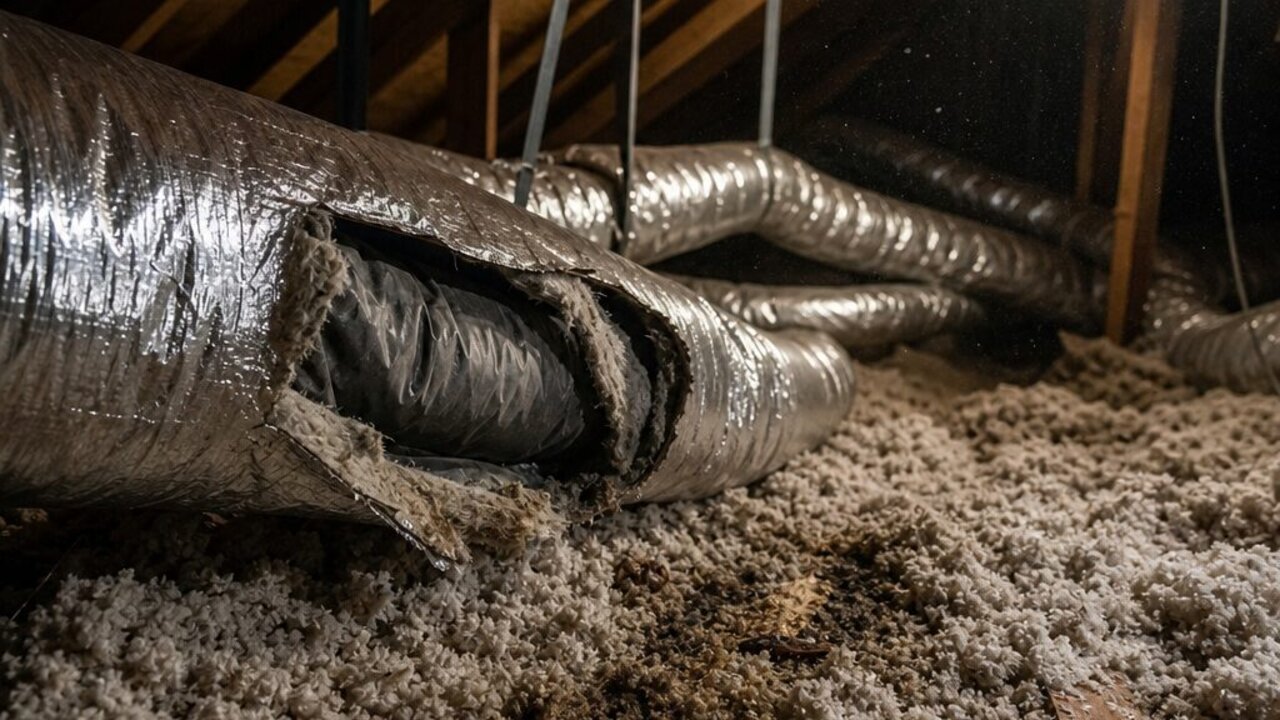
The complaint is almost always the same. It's not a constant smell — it comes and goes, it's strongest in the first minute after the air handler starts, and it's worse in one or two rooms than the rest of the house. Homeowners describe it as ammonia, or musty, or "like a pet accident somewhere we can't find."
In Ghent (23507) and Larchmont (23505), that pattern points almost every time to the same source: the HVAC system is pulling air from a contaminated attic or crawl space and delivering it to your living areas. The vents aren't the problem. They're the delivery mechanism.
Why Norfolk's Older Neighborhoods Share Air Between Floors and Attics
Ghent is one of the oldest intact residential neighborhoods in the region — Victorians, Colonial Revivals, and four-squares built largely between the 1890s and the 1920s around the Hague, on tight lots with shared walls and narrow side yards. Larchmont, developed a couple of decades later along the Lafayette River near what is now Old Dominion University, is dominated by 1920s through 1940s homes under a heavy oak canopy.
Both were built long before anyone thought about air barriers. What that means in practice:
Unsealed chases and penetrations.Balloon-framed walls, old plumbing stacks, chimney chases, and knob-and-tube electrical routes create open vertical pathways between the crawl space, the wall cavities, and the attic. Air moves through them freely.
Retrofitted HVAC in unconditioned space.These homes didn't have central air originally. When systems were added, the ductwork went wherever there was room — usually the attic, the crawl space, or both. Decades-old flex duct with degraded mastic at the joints leaks on both the supply and return side.
The stack effect.Warm air rises and escapes at the top of the house, which pulls replacement air in at the bottom. In a Ghent home with a vented crawl space and a leaky attic, that replacement air comes from exactly the two places you least want it to.
Put a rodent infestation into that system and the contamination doesn't stay in the attic. A leaking return duct in a contaminated attic actively draws attic air into the supply stream and pushes it out of every register in the house.
⚠ Why This Is a Health Issue, Not a Comfort Issue
The CDC identifies hantavirus as a serious risk associated with rodent droppings, urine, and nesting material in enclosed spaces, transmitted by breathing airborne particles rather than by direct contact. Confirmed Hantavirus Pulmonary Syndrome cases carry an approximate38%mortality rate. The CDC additionally lists leptospirosis, salmonella, and lymphocytic choriomeningitis among diseases associated with rodents. An HVAC system drawing air across contaminated material gives those particles a route into occupied rooms.CDC guidance on hantavirus prevention.
How to Tell Whether It's the Attic or the Crawl Space
Odor strongest upstairs, worse on hot afternoons.Attic-side. Heat drives off ammonia from dried urine, and a hot attic pressurizes downward through ceiling penetrations — recessed lights, bath fans, attic hatches.
Odor strongest on the first floor, worse in humid weather.Crawl space side. Damp soil and a torn vapor barrier carry organic odor upward through floor penetrations.
Odor tied to the HVAC cycle regardless of floor.Duct involvement. If the smell arrives with airflow and fades when the system stops, the contamination is in or immediately around the ductwork.
A fine dark dust on furniture near registers.Take this one seriously. It can indicate that particulate from the attic or duct interior is being distributed through the system.
Cleaning the Ducts Alone Won't Fix It
This is the part homeowners get wrong most often. Duct cleaning is genuinely necessary when ducts are involved — but if the contaminated insulation is still sitting on the attic floor around those ducts, the system re-contaminates itself within weeks. The reverse is also true: replacing attic insulation while leaving rodent waste inside the duct runs leaves the distribution path fully intact.
The correct sequence for a Ghent or Larchmont home is: seal the entry points, remove the contaminated insulation, sanitize the deck, clean and sanitize the duct system, then install new insulation. Universal Pest & Termite handles the exclusion side through theirrodent removal serviceand theirNorfolk pest controlteam; Universal Duct Cleaning handlesduct cleaning in Norfolk; we handle removal, sanitizing, and reinstallation. All three schedule as one project.
What Restoration Looks Like in a Century-Old Norfolk Home
Older homes need a lighter touch than a 1990s subdivision. Plaster ceilings crack under careless foot traffic, knob-and-tube wiring may still be live in places, and attic access in a Ghent four-square is frequently a scuttle hole in a closet rather than a pull-down stair. Extraction has to be done with hose runs and containment rather than by dragging bags through finished space.
Air sealing matters more here than almost anywhere else in Norfolk. Sealing the top-plate penetrations, chases, and can-light housings before new insulation goes down is what actually breaks the air pathway between the attic and the bedrooms. Insulation alone doesn't stop air movement — it slows heat transfer. Sealing stops the air.
Neighborhood detail is on ourGhent attic insulation,Larchmont attic insulation, andGhent crawl spacepages, with the full scope onNorfolk insulation removal. If you want the deeper background, we've also written aboutrodent-contaminated insulation in Larchmontandrodents in air ducts.
Frequently Asked Questions
Would an air purifier or a better filter solve the smell?
No. A higher-MERV filter sits on the return side and can capture some particulate, but it does nothing about gaseous odor compounds and nothing about the source. Homeowners who go this route usually report a small improvement for a few weeks. The odor returns because the contaminated material is still in the airstream's path. Filtration is a supplement to remediation, not an alternative.
Still finding droppings after the traps went quiet? Book a free attic inspection
My Ghent house is a duplex conversion. Does contamination move between units?
It can. Converted homes in Ghent frequently share an attic volume, a crawl space, or open wall chases even when the living areas are fully separated, and older conversions rarely have a continuous air barrier between units. If one unit has confirmed rodent activity, the shared spaces should be inspected as a whole rather than unit by unit.
Want to see how contaminated material actually comes out? How insulation removal works
Can you tell me it's rodent contamination before you open the attic?
Not with certainty, and we won't guess. Ammonia-type odors can also come from a failed condensate drain, standing water in the crawl space, or animal activity other than rodents. That's why the inspection is free: we look at the attic, the crawl space, and the duct routing, and then tell you what's actually there — including if the answer is that you don't need us.
Wondering what Pest Guard adds on the reinstall? About Pest Guard Insulation™
Free Air Quality & Attic Inspection for Norfolk Homeowners
We serve Ghent, Larchmont, and all ofNorfolkwith free inspections that cover the attic, the crawl space, and the duct routing between them.
Ready for a Free Estimate?
Universal Insulation Doctor serves all of Hampton Roads. Call now or fill out our quick form — we'll get back to you same day.
Have a Question?
Can't find the answer you're looking for? Our team is always happy to help. Give us a call or fill out the form for a free no-obligation consultation.
(757) 962-0340