

When to Replace Sub-Floor Insulation (and What Happens If You Wait)
May 5, 2026
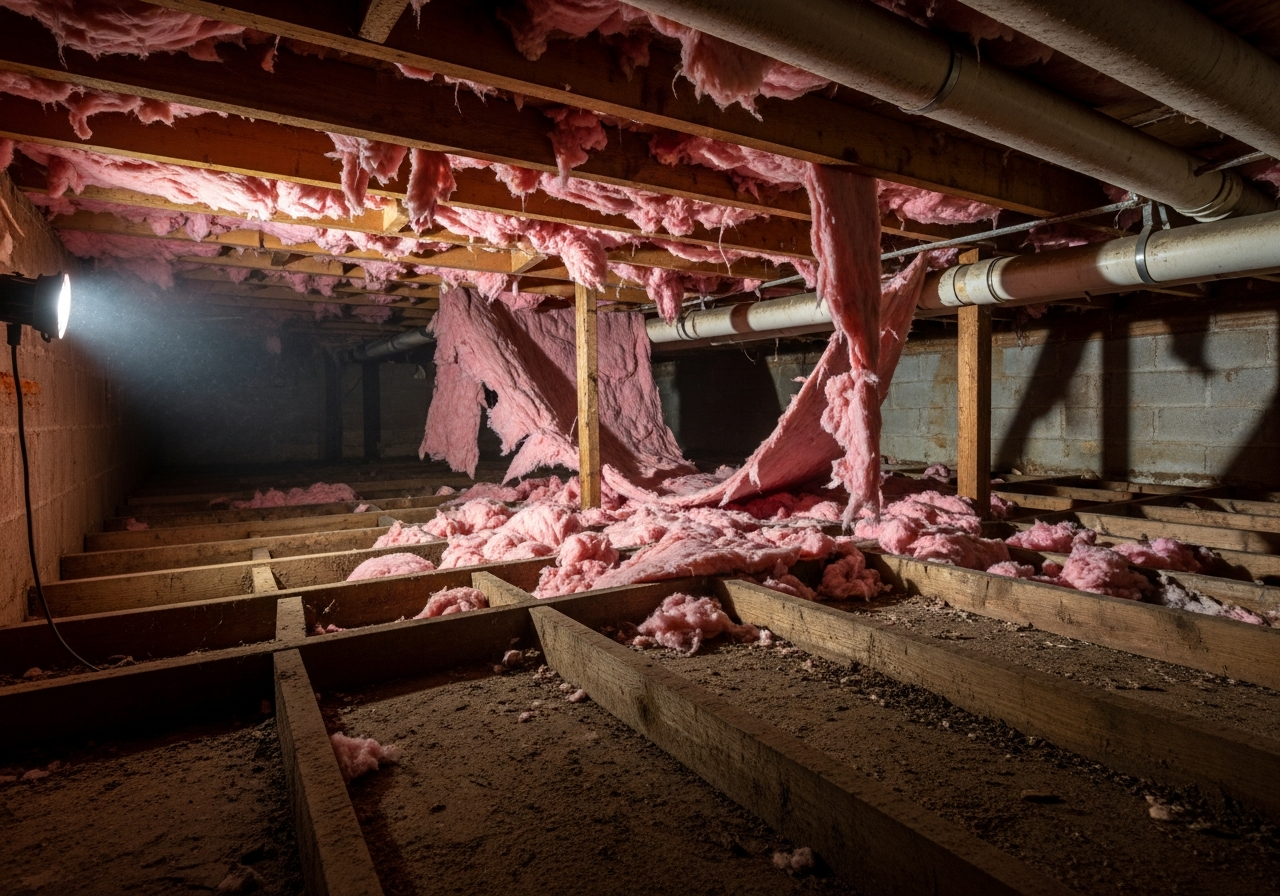
Sub-floor insulation — the insulation installed between the floor joists of homes built on crawl space foundations — is one of the least visible, least inspected components of a home's building envelope. Most homeowners have no idea what condition theirs is in. In Hampton Roads, where crawl space humidity is a year-round challenge, sub-floor insulation failure is common and carries real consequences for energy bills, floor comfort, indoor air quality, and eventually, structural integrity. Here's what to look for and when to act.
How Sub-Floor Insulation Fails in Hampton Roads
Standard sub-floor insulation is fiberglass batts cut and friction-fit between floor joists. This installation method works adequately in dry climates. In the coastal humidity of Virginia Beach, Chesapeake, and Norfolk, it has a significant vulnerability: fiberglass batts absorb moisture when crawl space humidity is chronically elevated.
Once saturated, fiberglass batts become heavy, lose their structural integrity, and begin to sag and fall out of the joist bays — a process that can take anywhere from 5 to 15 years depending on moisture levels. As they sag, they pull away from the subfloor and leave gaps. Eventually they drop onto the crawl space floor entirely. At this point, the floor above is essentially uninsulated — sitting directly above an unconditioned, humid space.
Signs Your Sub-Floor Insulation Has Failed
- Cold floors in winter:If your first-floor floors are noticeably cold underfoot in winter despite heating the living space, sub-floor insulation failure is a likely cause. Heat is escaping through the uninsulated joist bays into the crawl space below.
- Warm floors in summer:The same physics work in reverse. A crawl space that reaches 85–90°F in summer radiates heat upward through bare floor joists.
- Higher-than-expected energy bills:A failed sub-floor insulation layer adds load to your HVAC system year-round. The increase isn't dramatic in any single month, but it compounds — and it's wasted money.
- Musty odors on the first floor:Wet or moldy insulation hanging from the joist bays is a direct moisture and odor source that feeds the stack effect into living areas.
- Visible sagging or fallen insulation:If you look into your crawl space and can see insulation batt sections hanging down at angles or lying on the ground, replacement is overdue.
What Happens If You Wait
The consequences of delayed sub-floor insulation replacement are not just thermal. Wet insulation that remains in contact with wood floor joists feeds moisture to the wood over time. The result is wood rot — the slow deterioration of the structural members supporting your floors. Joists that have rotted significantly are no longer carrying their design load and must be sistered or replaced, a repair that costs far more than insulation replacement.
Wet insulation is also a substrate for mold. Mold growing on insulation in the joist bays has direct access to the stack effect pathway into the living area. Delayed replacement of failed insulation is one of the most common ways crawl space mold problems escalate into whole-home air quality issues.
The Right Replacement Approach
Replacing failed sub-floor insulation requires more than just pulling out the old batts and pushing in new ones. Oursub-floor insulation servicefollows a specific process: full removal of all existing contaminated material, inspection of the joist framing for rot or mold, treatment of any affected wood, and installation of new insulation with proper support to prevent future sagging.
In most Hampton Roads homes, replacing sub-floor insulation in isolation only provides a partial solution if the underlying crawl space moisture problem isn't addressed at the same time. New batts installed into a still-vented, high-humidity crawl space will degrade again on the same timeline as the old ones. For a permanent fix, sub-floor insulation replacement is most effectively paired withcrawl space encapsulation— a sealed liner system that controls crawl space humidity year-round.
How Long Should Sub-Floor Insulation Last?
In a properly encapsulated crawl space with humidity maintained below 55%, quality sub-floor insulation should last 20–25 years. In a vented crawl space in Hampton Roads — without moisture control — 10–15 years is a more realistic expectation, and some installations fail in 7–8 years in particularly wet locations. If you don't know when your sub-floor insulation was last replaced and your home is more than 10–12 years old, it's worth an inspection.
Schedule a Free Crawl Space Inspection
Universal Insulation Doctor serves all of Hampton Roads — Virginia Beach, Chesapeake, Norfolk, Portsmouth, Hampton, Newport News, Suffolk, and Williamsburg. Our free inspections include a complete crawl space assessment, photos, moisture readings, and a written recommendation. There's no cost and no obligation. Call us at757-962-0340or visit ourfree estimate pageto schedule.
Ready for a Free Estimate?
Universal Insulation Doctor serves all of Hampton Roads. Call now or fill out our quick form — we'll get back to you same day.
Have a Question?
Can't find the answer you're looking for? Our team is always happy to help. Give us a call or fill out the form for a free no-obligation consultation.
(757) 962-0340