

Rodent-Contaminated Insulation in Edinburgh, Chesapeake: What Homeowners Need to Know
June 29, 2026
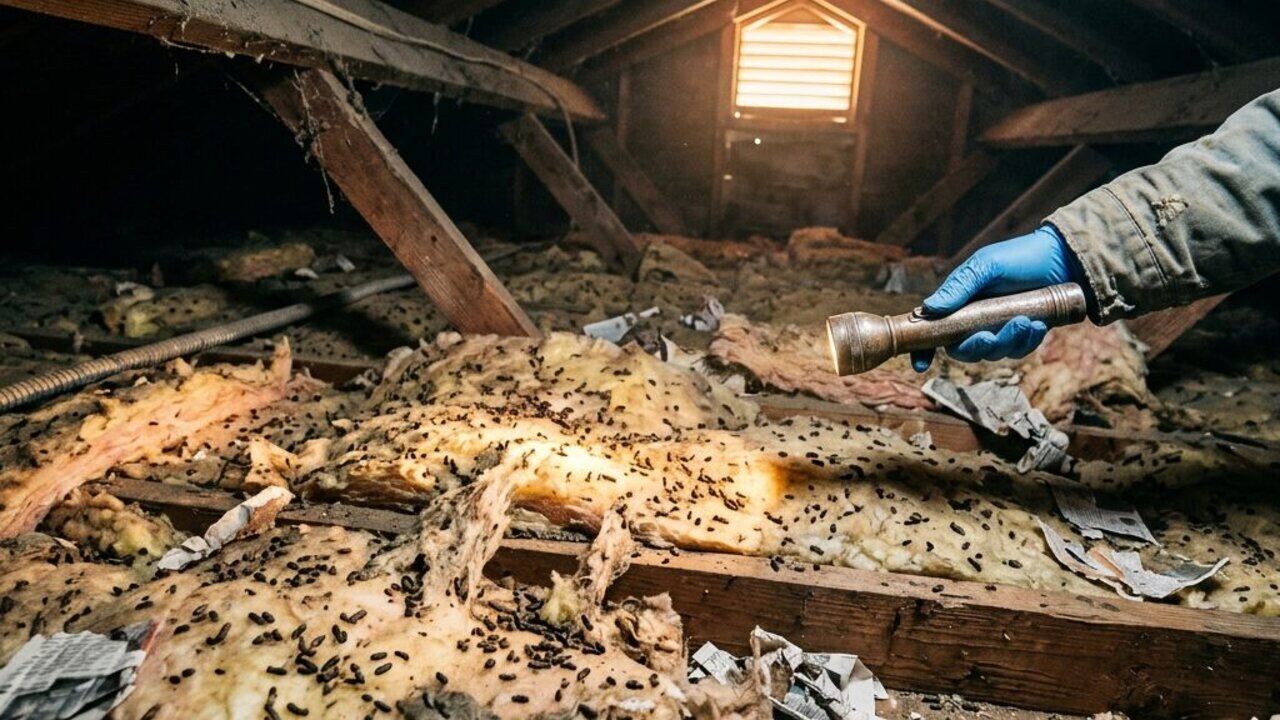
Edinburgh (Chesapeake, VA 23322) is one of Chesapeake's established residential neighborhoods — well-kept homes, mature trees, and the kind of quiet streets that make it an attractive place to live. It's also exactly the kind of environment where rodents thrive. Mature tree canopy provides highway-level access to rooflines. Older home construction often means gaps at the soffit, fascia, and ridge that a mouse or rat can exploit with ease. And once they're in the attic, the insulation already there becomes their nesting material, bathroom, and food cache all at once.
If you've heard scratching in the ceiling, noticed an ammonia-like odor in certain rooms, or had a pest inspector confirm rodent activity in your attic, the insulation question is next — and it's an important one. Contaminated attic insulation isn't a cosmetic problem. It's a health issue, a structural issue, and an efficiency issue rolled into one.
Signs That Rodents Have Been in Your Attic
Rodent activity in attics doesn't always announce itself loudly. By the time most Edinburgh homeowners notice a problem, the infestation has often been established for weeks or months. The most common signs include:
Scratching or scurrying sounds.Rodents are most active at night. If you hear movement above your ceiling after dark — particularly from one area to another, suggesting travel — that's a strong indicator of active rodent presence.
Unusual odors.Rodent urine has a sharp, ammonia-heavy smell that can permeate through insulation and eventually into your living space through the stack effect. A musty or ammonia smell that seems to come from your ceiling or HVAC vents is worth investigating immediately.
Droppings near the attic access or in the attic itself.Rodent droppings are small, dark, and pellet-shaped — roughly the size of a grain of rice for mice, slightly larger for rats. Finding them on or near the attic stairs, in the attic itself, or near insulation that has been disturbed or displaced is definitive evidence.
Damaged or flattened insulation.Rodents nest by burrowing into and compressing insulation. Areas where the insulation looks disturbed, tunneled through, or significantly flattened may indicate active or past nesting sites.
Entry points at the roofline.Gaps at the soffit, holes around pipe penetrations, or deteriorating fascia boards are common entry routes. If your pest inspector has identified or sealed entry points, assume the insulation inside has been compromised.
Why Contaminated Insulation Is a Serious Health Risk
This is the part that homeowners sometimes underestimate. Rodent contamination in attic insulation is not simply a hygiene nuisance — it carries real, documented health risks that the EPA and CDC both take seriously.
Rodent droppings, urine, and nesting material can carry hantavirus, leptospirosis, and salmonella, among other pathogens. Hantavirus is the most serious: transmitted through breathing in airborne particles from dried rodent droppings or urine, it causes Hantavirus Pulmonary Syndrome, which has a mortality rate of approximately 38% in confirmed cases. While infection is not common, the risk is real and the mechanism — airborne particles in enclosed spaces like attics — is directly relevant to how attic insulation is disturbed.
Because of the stack effect, your home continuously draws air upward from the attic and through wall cavities into your living space. Contaminated insulation that sits undisturbed may not be actively releasing particles into your home's air — but any disturbance, including HVAC operation that draws from attic-adjacent spaces, can move contaminated particulates downward.
Why Full Replacement Is the Only Safe Option
A common instinct after rodent remediation is to spot-clean or partially replace the insulation — pull out the obviously damaged sections, sanitize, and move on. This approach sounds efficient, but it isn't adequate for a few reasons.
First, contamination spreads well beyond visible nesting sites. Rodent urine soaks into insulation material across a wide radius, and the dried residue is invisible. You cannot reliably identify every contaminated zone by visual inspection alone. Partial replacement leaves contaminated material in place.
Second, old insulation that has been compressed by rodent activity has already lost significant thermal value. Fiberglass insulation achieves its R-value through the air trapped in its structure — when that structure is compressed or matted down by nesting, the R-value drops proportionally. Patching around damaged areas doesn't restore the thermal performance of the compromised sections.
Third, proper remediation requires complete removal so the attic subfloor can be inspected, sanitized, and sealed before new insulation is installed. Any entry points — gaps, cracks, and penetrations — must be sealed during this window. Installing new insulation over an unsealed attic simply gives the next rodent a freshly prepared home.
Universal Insulation Doctor'sinsulation removal processincludes full extraction of contaminated material, HEPA vacuuming of the attic deck, and application of an antimicrobial sanitizing treatment before any new insulation is installed.
Pest Guard Insulation™: Protection After Remediation
Once the contaminated insulation is out, the attic has been sanitized, and entry points have been sealed, the choice of replacement insulation matters. Standard blown-in fiberglass will restore your R-value — but it offers no deterrent to future pest activity.
Universal Insulation Doctor installsPest Guard Insulation™ for Chesapeake homes, a borate-treated fiberglass option described as intended to deter certain insects. Ask for the current label to confirm listed insects, approved use, and treatment duration. It does not deter rodents or replace structural exclusion.
Rodent-Proofing Before Re-Insulation
Sealing the attic against re-entry is a prerequisite for new insulation — not an afterthought. Even a thorough remediation is wasted if the entry points that allowed the original infestation are still open. Common entry points in Edinburgh's older Chesapeake homes include gaps where roofline meets fascia, deteriorating soffit panels, openings around plumbing and electrical penetrations, and ridge cap gaps.
For active infestations or if you need a professional assessment of rodent entry points, Universal Insulation Doctor works in coordination with our sister company, Universal Pest & Termite. Their team specializes in rodent activity in Chesapeake's attic spaces — you can read more about their approach torodents in Chesapeake atticson their site. Coordinating pest control and insulation replacement as a single project ensures nothing falls through the cracks between trades.
Air Duct Cleaning: The Step Most Homeowners Miss
Here is where many homeowners stop short, and it's a costly mistake. After a rodent infestation in the attic, the HVAC ductwork that runs through or adjacent to that attic space must be inspected and cleaned before the remediation is considered complete.
Rodents frequently travel along and through ductwork. They nest inside ducts, leave droppings, and deposit urine — and when your HVAC system runs, it actively circulates air through those contaminated ducts directly into every room of your home. Installing new insulation and moving on without addressing the duct system means your family is still breathing air that has passed through the contaminated zone every time the heat or air conditioning kicks on.
Professional air duct cleaning removes accumulated rodent debris, sanitizes duct interiors, and restores the system to safe operating condition. For Edinburgh and broader Chesapeake homeowners, Universal Duct Cleaning provides professionalduct cleaning services in Chesapeakeand can coordinate directly with Universal Insulation Doctor so both steps — insulation replacement and duct cleaning — are completed as a single remediation project. This is the correct sequence: remove contaminated insulation, clean and sanitize ducts, seal entry points, install new insulation. Skipping any of these steps leaves the remediation incomplete.
Schedule a Free Inspection for Your Edinburgh Home
If you've had rodent activity confirmed in your attic — or if you suspect it — don't wait. The longer contaminated insulation sits, the more opportunity there is for pathogens to spread and for secondary pest problems to develop. Universal Insulation Doctor serves Edinburgh (23322) and all ofChesapeakewith free, no-obligation attic inspections. We'll assess the extent of the contamination, identify entry points, and provide a written estimate for full remediation and re-insulation.
Call(757) 962-0340to schedule your free inspection, orrequest a free estimate online. Our team is locally based, licensed, and experienced with exactly the kind of pest-contamination remediation that Edinburgh homeowners are dealing with.
Ready for a Free Estimate?
Universal Insulation Doctor serves all of Hampton Roads. Call now or fill out our quick form — we'll get back to you same day.
Have a Question?
Can't find the answer you're looking for? Our team is always happy to help. Give us a call or fill out the form for a free no-obligation consultation.
(757) 962-0340