

Do Ants Nest Behind Insulation? What Hampton Roads Homeowners Need to Know
July 12, 2026
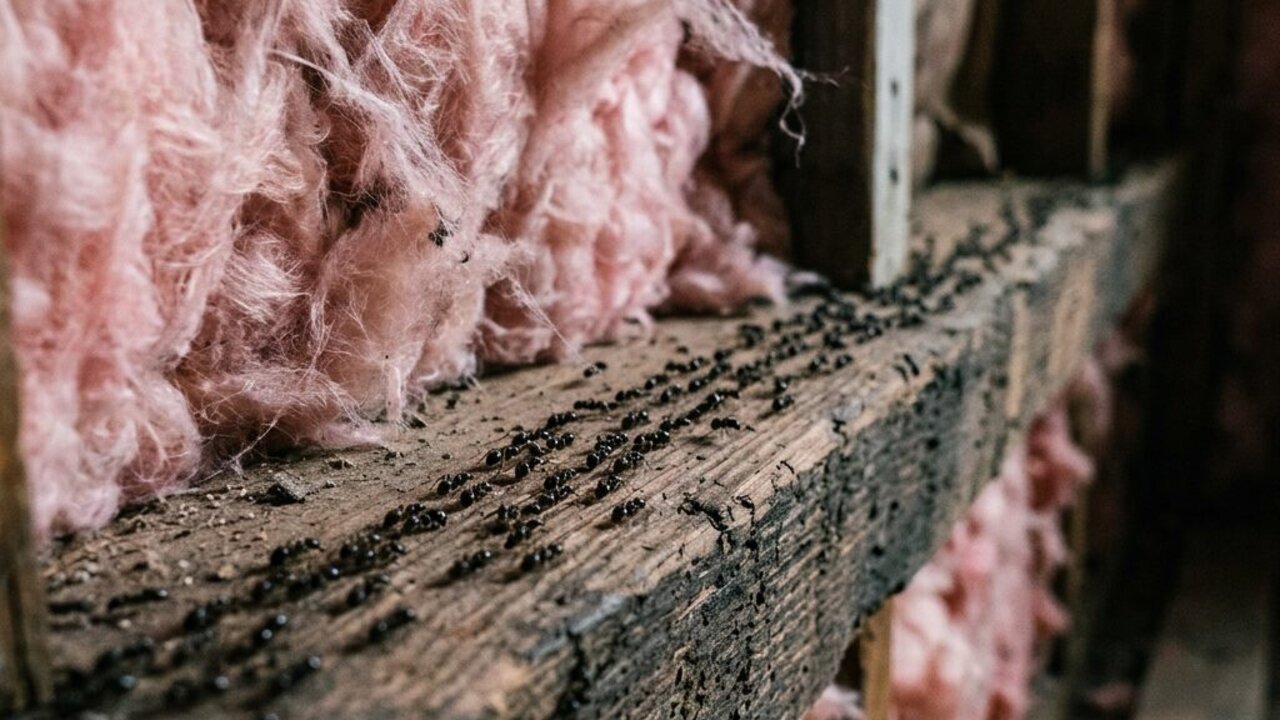
The short answer is yes. Ants nest behind, within, and around insulation in Hampton Roads attics and crawl spaces regularly — and they do more damage than most homeowners realize. Across Virginia Beach, Norfolk, Chesapeake, and Portsmouth, three species are responsible for the majority of insulation-related ant problems: carpenter ants, fire ants, and odorous house ants. Each has different behavior, different damage patterns, and requires a different treatment approach.
This guide covers what each ant species does inside your insulation, how to recognize an infestation, why ant colonies in insulation can't be treated with store-bought products, and why ant removal and insulation restoration need to happen in the correct sequence.
Carpenter Ants: The Most Destructive Species in Hampton Roads Attics
Carpenter ants —Camponotusspecies, primarilyCamponotus pennsylvanicus(black carpenter ant) in Virginia — are the most structurally damaging ant species found in Hampton Roads homes. They do not eat wood, but they excavate it to create nesting galleries, producing a fine sawdust-like material called frass that accumulates near nesting sites.
In attic environments, carpenter ants prefer wood that has been softened by moisture. This is why they are commonly found in attics where roof leaks, poor ventilation, or high humidity have elevated the moisture content of rafters and sheathing. Insulation is not their primary target, but nests are regularly established within fiberglass batt insulation adjacent to damaged wood, and the ants tunnel through insulation as they expand gallery systems.
Signs of carpenter ants in insulation: large (¼ to ½ inch) black or bicolored ants inside the home or attic, small piles of frass near wall voids or attic access points, and the sound of rustling or crackling inside walls — particularly in older construction in neighborhoods likeGhent (Norfolk),Churchland (Portsmouth), andPhoebus (Hampton)where aging housing stock provides ideal moisture conditions.
Treatment:Carpenter ant elimination requires identifying and treating satellite and parent colonies, which may be located in the attic, in wall voids, or in stumps and dead wood near the home's perimeter. Our sister companyUniversal Pest & Termiteprovidescarpenter ant treatment across Hampton Roadsusing targeted baiting and residual product applications that eliminate the full colony — not just forager ants.
Fire Ants: The Ground-Up Threat to Crawl Space Insulation
Red imported fire ants (Solenopsis invicta) are ubiquitous across Hampton Roads. Virginia Beach, Chesapeake, and Suffolk have particularly high fire ant pressure due to the combination of sandy soil, open lawn areas, and the warm climate that fire ants prefer. Fire ants are a crawl space insulation problem, not an attic problem — they build extensive mound and tunnel systems in the soil beneath homes and can establish satellite colonies within the vapor barrier, between floor joists, and directly within fiberglass batt insulation installed in the crawl space.
Fire ant nests within crawl space insulation are difficult to detect without inspection. The insulation provides the ants with thermal mass and moisture protection. In established infestations, fire ants create chambers within fiberglass batts that are visible only when insulation is removed. More commonly, fire ant pressure in the crawl space is identified when homeowners notice small mounds along the foundation perimeter or when pest inspectors find tunnel systems in the vapor barrier during a crawl space inspection.
In crawl spaces without vapor barriers or encapsulation — common in older Chesapeake and Virginia Beach homes in neighborhoods likeIndian RiverandKempsville— fire ant colonies have direct soil access and can become very large before detection.
Treatment:Fire ant elimination in crawl spaces requires broadcast bait treatment and, for established colonies, targeted mound drench.Universal Pest & Termite's fire ant control programaddresses both perimeter colonies and any infiltration into the crawl space itself. Once fire ant activity is eliminated, Universal Insulation Doctor removes ant-compromised insulation and installs Pest Guard Insulation™ — our borate-enhanced insulation product that actively deters future ant activity as part of the insulation system.
Odorous House Ants: The Indicator Species for Moisture Problems
Odorous house ants (Tapinoma sessile) — named for the coconut-like odor they release when crushed — are among the most common ant species in Hampton Roads homes and are frequently found in both attic and crawl space insulation. Unlike carpenter ants, they do not damage wood. Unlike fire ants, they do not build elaborate mound systems. They are opportunistic nesters that establish colonies wherever conditions are moist and food is accessible.
When odorous house ants appear in crawl space insulation in significant numbers, it is almost always a moisture signal. These ants specifically seek moist environments for nesting. Finding them in your insulation is a reliable indicator that the insulation is damp — which confirms a moisture problem that needs to be addressed regardless of the ant infestation itself.
This is why at Universal Insulation Doctor we treat every ant-related insulation inspection as a potential moisture investigation. Eliminating the ants without addressing the moisture guarantees re-infestation.
Why Store-Bought Ant Products Don't Work on Insulation Infestations
Ant colonies nesting within attic or crawl space insulation are not accessible to the spray products sold at hardware stores. Contact sprays kill forager ants — the workers you see — but do nothing to the colony itself, which continues to reproduce at full capacity. Without eliminating the queen and the colony structure, infestations persist indefinitely regardless of how many foragers are killed.
Professional ant treatment uses baiting systems that forager ants carry back to the colony, killing the queen and ending reproduction at the source. This requires product selection, bait placement, and monitoring by a licensed pest control professional.Universal Pest & Termiteprovides licensed ant control treatment across all of Hampton Roads, including Virginia Beach, Norfolk, Chesapeake, Portsmouth, Newport News, Hampton, and Suffolk.
Ants in Your Insulation? Two Calls, One Coordinated Fix.
Universal Insulation Doctor coordinates directly with Universal Pest & Termite to sequence ant elimination and insulation replacement correctly — pest treatment first, then Pest Guard Insulation™ installation. One call to (757) 962-0340 starts both processes.
The Correct Sequence: Pest Treatment, Then Insulation
The single most important rule for ant-related insulation problems: pest treatment must happen before new insulation is installed. Installing fresh insulation into an attic or crawl space that still has an active ant colony provides the colony with a new, undisturbed nesting substrate. The infestation continues — in your brand-new insulation.
The correct sequence:
- Pest inspection—Universal Pest & Termiteidentifies the ant species, colony locations, and entry points.
- Ant treatment— Colony elimination using professional baiting and/or treatment appropriate to the species.
- Insulation removal— Universal Insulation Doctor removes all ant-compromised insulation, exposing the full nesting area for assessment.
- Moisture assessment— If ants were associated with moisture (as with odorous house ants), moisture source is identified and addressed.
- Pest Guard Insulation™ installation— Universal Insulation Doctor installs borate-enhanced Pest Guard Insulation™, which is intended to deter certain insects.
Pest Guard Insulation™: The Insulation That Fights Back
Universal Insulation Doctor is a local contractor that installsPest Guard Insulation™— a borate-enhanced blown-in fiberglass product that provides both standard thermal insulation and active pest deterrence. The borate compound is integrated into the glass fiber matrix during manufacture, making it permanent and non-degrading. It deters crawling insects — including ants — without pesticide odors, without requiring re-application, and without any ongoing maintenance.
For Hampton Roads homes in neighborhoods likeGreat Neck,Great Bridge, andTalbot Parkthat have experienced ant activity in their attic, Pest Guard Insulation™ is the replacement product of choice — it restores R-value while actively preventing recurrence.
Frequently Asked Questions
Can ants actually damage my insulation or do they just live in it?
It depends on the species. Carpenter ants excavate galleries in both wood and insulation, physically destroying the material. Fire ants and odorous house ants nest within existing voids and spaces in fiberglass insulation rather than excavating it — but they compress, displace, and contaminate it, reducing R-value and leaving pheromone trails that attract future infestations. Any ant colony in your insulation is a reason for inspection and likely replacement.Call (757) 962-0340to schedule a free assessment.
Still finding droppings after the traps went quiet? Book a free attic inspection
I see ants in my home but I'm not sure if they're in the insulation. How do I find out?
A pest inspection fromUniversal Pest & Termitewill identify the ant species and likely colony location. A simultaneous insulation inspection from Universal Insulation Doctor will assess whether the insulation has been compromised. We coordinate both inspections when a homeowner calls our main number.Call (757) 962-0340to get started.
Want to see how contaminated material actually comes out? How insulation removal works
Are fire ants a common problem in Virginia Beach and Chesapeake crawl spaces?
Yes — Virginia Beach and Chesapeake have some of the highest fire ant pressure in Virginia, driven by the sandy soil, warm climate, and active lawn environments common across neighborhoods like Kempsville, Greenbrier, and Indian River. Crawl space fire ant infestations are more common than most homeowners realize because they go undetected until they're large.Universal Pest & Termite's fire ant treatmentcovers crawl space colonies —call (757) 962-0340to coordinate an inspection.
Wondering what Pest Guard adds on the reinstall? About Pest Guard Insulation™
Does Pest Guard Insulation™ actually stop ants, or is it just regular insulation?
Pest Guard Insulation™ is genuine thermal insulation with an integrated borate compound — a naturally-occurring mineral that is toxic to insects when ingested. Ants that contact or consume borate-treated material are deterred from nesting. The borate is integrated into the glass fiber during manufacture, so it does not off-gas, does not require re-application, and does not degrade over time. Universal Insulation Doctor is Hampton Roads' installer.Learn more about Pest Guard Insulation™or call(757) 962-0340.
Need a number for your own home? See current pricing
How much does ant-related insulation replacement cost in Norfolk or Virginia Beach?
Insulation replacement after ant damage ranges from$1,500 to $4,500+depending on the space, the extent of damage, and whether encapsulation is needed in the crawl space. Pest Guard Insulation™ is priced comparably to standard blown-in insulation — the pest deterrence is built into the product at no significant premium. Universal Insulation Doctor provides free written estimates after inspection.Get your free estimateor call(757) 962-0340.
Still finding droppings after the traps went quiet? Book a free attic inspection
Free Insulation Inspection — Ant Damage Assessment
Universal Insulation Doctor provides free attic and crawl space inspections across Hampton Roads. If ants are involved, we coordinate directly with Universal Pest & Termite to sequence treatment and installation correctly — no re-infestation of new insulation.
Ready for a Free Estimate?
Universal Insulation Doctor serves all of Hampton Roads. Call now or fill out our quick form — we'll get back to you same day.
Have a Question?
Can't find the answer you're looking for? Our team is always happy to help. Give us a call or fill out the form for a free no-obligation consultation.
(757) 962-0340