

Hampton Roads is one of the most moisture-challenging regions in the country for residential foundations. Virginia Beach, Chesapeake, and Norfolk sit at or near sea level with a high water table, frequent heavy rainfall, and ambient humidity that rarely drops below 60% even in winter. For the tens of thousands of homes with crawl space foundations across the region, moisture isn't a possibility — it's an inevitability that has to be actively managed. Here's how to tell if it's already become a problem in your home.
Signs You Can See Without Going Under the House
Musty or Earthy Odors Indoors
The stack effect pulls air upward through your home from the lowest point — your crawl space — to the highest point. If your crawl space smells musty, damp, or like soil, that air is moving into your living areas. A persistent musty smell anywhere in the home, especially on the first floor or in a basement-adjacent area, is one of the most reliable indicators of crawl space moisture.
Buckling, Warping, or Soft Hardwood Floors
Wood is hygroscopic — it absorbs and releases moisture constantly. When crawl space humidity is chronically high, the subfloor and the finished flooring above it absorb that moisture over time. The result is hardwood that cups, gaps, or feels spongy underfoot. This damage is often irreversible once it progresses far enough.
Visible Mold on the Lower Walls or Around the HVAC System
If mold is visible on the walls near the floor, around floor registers, or on the ductwork that runs through the crawl space, moisture levels in the substructure are almost certainly elevated. Mold requires sustained humidity above 60–70% relative humidity to colonize, which means the problem has been present long enough to reach that threshold.
High Indoor Humidity
If your home feels persistently humid despite running the air conditioner, your HVAC system may be fighting a losing battle against moisture infiltrating from below. A hygrometer (inexpensive at any hardware store) will tell you your indoor relative humidity. Anything above 55% on the first floor of a home with a crawl space warrants investigation.
Signs You'll Find by Inspecting the Crawl Space
Standing Water or Wet Soil
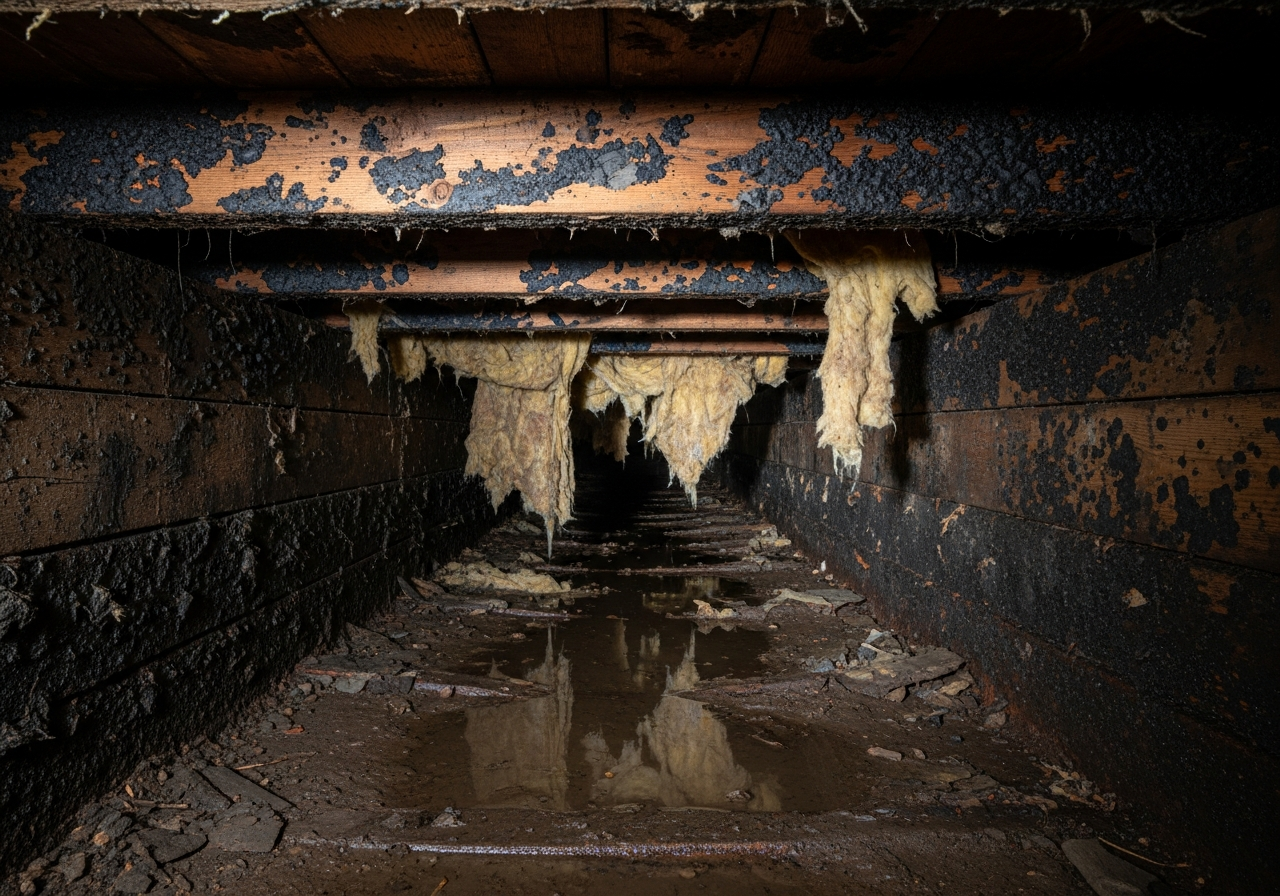
Any standing water in a crawl space is an emergency. It means active water intrusion — from a plumbing leak, groundwater, or surface water finding its way in through the foundation. Even if the water dries up, the damage to wood framing, insulation, and any stored items continues in the form of mold and rot.
Condensation on HVAC Equipment, Pipes, or Ducts
When warm, humid air contacts cooler surfaces — supply ducts, water pipes, structural steel — it condenses. Sweating pipes or ducts in the crawl space indicate excessive ambient humidity. This condensation drips onto insulation and soil, adding moisture to the environment and accelerating mold growth.
Darkened, Sagging, or Falling Insulation
Sub-floor insulation that has absorbed moisture turns gray or brown and loses its loft — it compresses and eventually falls out of the joist bays onto the crawl space floor. If you see insulation hanging partially down or piled on the ground, it has been compromised by moisture and needs to be removed and replaced. Wet insulation provides essentially zero thermal benefit and actively contributes to wood rot and mold. Ourcrawl space insulationservice includes full removal of damaged material before installing new.
Dark Staining or Fuzzy Growth on Wood Framing
Any dark staining, fuzzy growth, or soft/spongy wood on the floor joists, sill plates, or beams is a serious warning sign. Wood rot and mold both indicate sustained moisture at levels high enough to support biological growth. Structural wood that has softened from rot cannot be restored — it must be sistered or replaced.
What to Do If You Find These Signs
The right solution depends on severity, but the approach is consistent: first fix the moisture source, then address any damaged materials, then install a long-term moisture control system. For most Hampton Roads homes, that meansfull crawl space encapsulation— a sealed liner system on the floor and walls, closed foundation vents, and a dehumidifier — combined with removal of any contaminated insulation and replacement with new sub-floor insulation.
Universal Insulation Doctor provides free crawl space inspections throughout Hampton Roads. We bring a camera, a moisture meter, and a flashlight — and we'll show you exactly what we find before recommending anything. Call757-962-0340to schedule your inspection at no charge.
Ready for a Free Estimate?
Universal Insulation Doctor serves all of Hampton Roads. Call now or fill out our quick form — we'll get back to you same day.
Have a Question?
Can't find the answer you're looking for? Our team is always happy to help. Give us a call or fill out the form for a free no-obligation consultation.
(757) 962-0340