

Crawl Space Encapsulation vs. Vapor Barrier: What's the Difference?
April 28, 2026
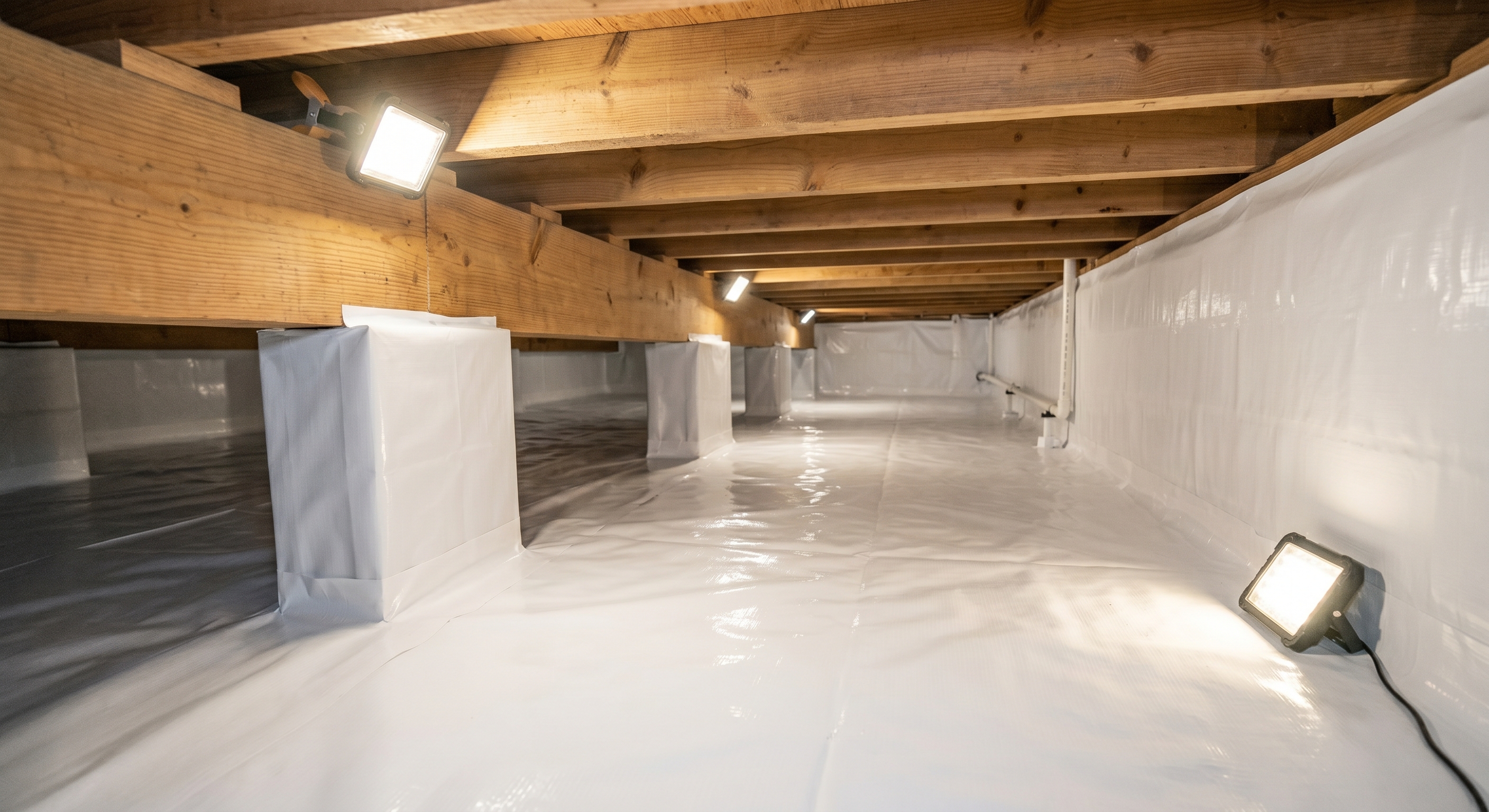
If you've started researching moisture solutions for your crawl space, you've probably seen the terms "vapor barrier" and "crawl space encapsulation" used as if they mean the same thing. They don't — and the difference matters enormously for Hampton Roads homes, where ground moisture and ambient humidity are year-round problems, not seasonal ones. Understanding what each solution actually does will help you make a smarter investment.
What Is a Vapor Barrier?
A vapor barrier — sometimes called a ground cover or vapor retarder — is a sheet of polyethylene plastic laid over the exposed soil of a crawl space floor. Its job is to slow the evaporation of ground moisture into the air inside the crawl space. Standard vapor barriers are 6-mil plastic, though heavier 10-mil and 12-mil versions are available. A vapor barrier covers only the ground; it does not seal the walls, seal penetrations, or address the vents in the foundation walls.
A basic vapor barrier is better than nothing, and in very dry climates with good foundation venting, it can be adequate. Hampton Roads is not a dry climate. With average annual humidity between 72% and 78% in Virginia Beach and Chesapeake, a vapor barrier alone leaves a significant amount of moisture ungoverned — moisture that comes in through the vents, through the walls, and around every pipe, wire, and post that penetrates the plastic.
What Is Crawl Space Encapsulation?
Crawl space encapsulationis a complete moisture management system. It starts with a heavy-duty reinforced liner (typically 12-mil to 20-mil) that covers not just the floor but extends up and is sealed to all four foundation walls, around every column, and over every penetration. The crawl space vents are sealed and blocked. A dehumidifier is often installed to maintain relative humidity below 55% year-round. In many installations, a drainage mat goes underneath the liner to direct any water intrusion toward a sump pump.
The result is a fully conditioned, sealed space that is effectively separated from the outdoor environment. Moisture cannot enter through the ground, through the walls, or through the air. This transforms your crawl space from a liability into a stable, dry zone.
Why Hampton Roads Homes Need Encapsulation, Not Just a Vapor Barrier
Hampton Roads sits at sea level or just above it. Many neighborhoods in Chesapeake, Suffolk, and Portsmouth have high water tables that push ground moisture upward with intensity. Norfolk and Virginia Beach homes see storm surge flooding that can saturate the soil under a house for weeks after a heavy rain. In these conditions, a 6-mil sheet of plastic on the ground is overwhelmed quickly. It doesn't seal the walls. It doesn't stop the humid outside air from flowing through foundation vents every summer day.
High crawl space humidity leads directly to wood rot on the floor joists, mold growth on framing members, and degraded sub-floor insulation — all of which compromise your home's structural integrity and indoor air quality. Studies consistently show that 40–50% of the air in a home's living area enters through the crawl space via the "stack effect." Whatever is in your crawl space air, you and your family are breathing it upstairs.
Cost Comparison
A basic vapor barrier installation in Hampton Roads typically runs$800–$2,500depending on crawl space size and accessibility. Full encapsulation runs$5,500–$10,500depending on size, liner thickness, wall coverage, and whether existing insulation removal is required. Projects that also include a dehumidifier run$7,500–$16,500. Encapsulation has a broader scope and generally costs more upfront than a basic vapor barrier. The appropriate option depends on groundwater, drainage, humidity, wall coverage, equipment, and the home's existing conditions.
Which One Do You Need?
If your crawl space is dry, well-ventilated, and you live in a low-humidity region with no history of moisture issues — a vapor barrier may be sufficient. If you live in Hampton Roads (and particularly if your home is in a flood zone, near a tidal waterway, or has ever shown signs of moisture — wood rot, mold, musty odors, damaged insulation, or pest activity) — encapsulation is the appropriate solution.
Universal Insulation Doctor provides free crawl space inspections throughout Hampton Roads. We'll show you what's actually happening under your home — moisture readings, photos, and a clear recommendation — before you spend a dollar. Reach us at757-962-0340to schedule your inspection.
Ready for a Free Estimate?
Universal Insulation Doctor serves all of Hampton Roads. Call now or fill out our quick form — we'll get back to you same day.
Have a Question?
Can't find the answer you're looking for? Our team is always happy to help. Give us a call or fill out the form for a free no-obligation consultation.
(757) 962-0340