

Crawl Space Encapsulation vs. Insulation: What Virginia Beach Homes Actually Need
June 20, 2026
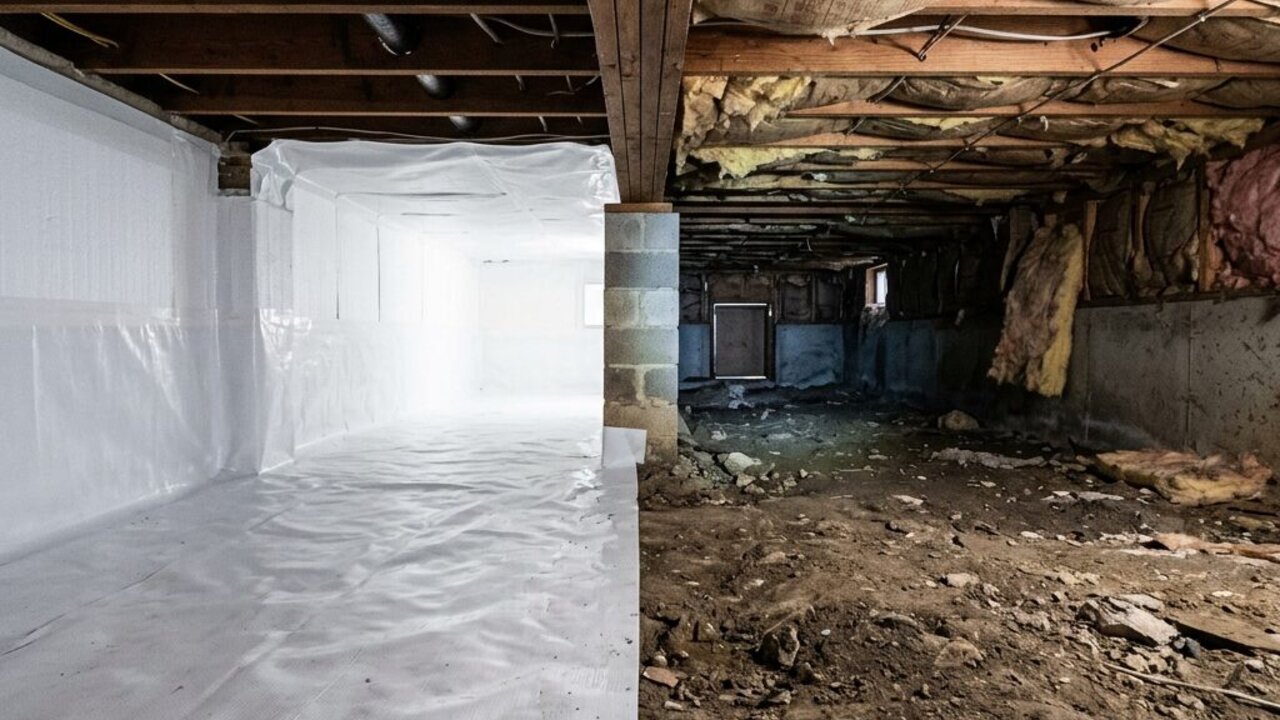
Contractors in Hampton Roads sometimes use "crawl space encapsulation" and "crawl space insulation" interchangeably. They shouldn't — these are two distinct services that solve different problems. Getting clear on the difference will help you understand what your home actually needs and avoid paying for the wrong solution (or the right solution installed incompletely).
What Crawl Space Insulation Does
Crawl space insulation refers to thermal material — typically rigid foam board or fiberglass batts — installed on the walls or floor joists of the crawl space to reduce heat transfer between the ground and your living areas. The goal is to keep your floors warmer in winter and reduce the load on your HVAC system. Insulation addresses temperature. It does not, by itself, address moisture.
In a dry climate with well-vented crawl spaces, insulation alone can be adequate. Hampton Roads is not a dry climate.
What Crawl Space Encapsulation Does
Crawl space encapsulationis a moisture management system. It involves installing a heavy-duty vapor barrier (typically 12-mil to 20-mil reinforced liner) across the entire floor and up all four foundation walls, sealing it at every seam and around every column and penetration, blocking foundation vents, and often adding a dehumidifier to maintain relative humidity below 55% year-round. The result is a fully sealed, conditioned space that is effectively separated from the outdoor environment.
Encapsulation addresses moisture. In most Hampton Roads homes, moisture is the primary threat — and moisture-damaged insulation provides almost no thermal benefit anyway.
Why Humidity Makes This Decision Easy in Hampton Roads
Virginia Beach averages annual relative humidity between 72% and 78%. The region sits at or near sea level across most of its footprint — Chesapeake, Suffolk, and Portsmouth neighborhoods often sit on top of high water tables that push ground moisture upward with real force. Foundation vents, which were designed to ventilate crawl spaces in drier climates, actively pull in humid coastal air every summer day, depositing moisture directly onto the wood framing of your floor structure.
The result, in unencapsulated crawl spaces, is predictable: wood rot on floor joists, mold on framing members, degraded insulation, higher HVAC costs, and musty odors that rise through the stack effect into your living areas. Studies consistently show that 40–50% of the air in a home's living space enters through the crawl space. What's in your crawl space air is in your home's air.
When Insulation Alone Is Sufficient
There are situations where addingcrawl space insulationwithout full encapsulation makes sense — primarily in homes that already have a fully encapsulated, dry, conditioned crawl space that simply lacks thermal insulation on the walls. If moisture is already controlled, layering in insulation is a straightforward efficiency upgrade.
For most Hampton Roads homes without any prior work, though, the correct sequence is: encapsulate first, insulate second. Installing insulation into a damp crawl space is counterproductive — wet insulation loses nearly all thermal value and becomes a habitat for mold.
Signs Your Crawl Space Needs Attention Now
Watch for musty or earthy smells anywhere in the home, cold or soft spots in your floors, visible condensation on windows in summer, or elevated allergy symptoms indoors. Any of these can indicate that moisture from an unprotected crawl space is already affecting your home's air and structure. Additional red flags include high indoor humidity readings above 60% relative humidity even with your HVAC running, sagging or soft spots in hardwood or laminate flooring (a sign that the subfloor below has absorbed moisture), and utility bills that keep rising without a clear explanation. The longer moisture damage goes unaddressed, the more expensive the remediation becomes — wood rot that could have been prevented with a $1,500 vapor barrier can eventually require $10,000 or more in structural repairs.
Doing Both at Once Saves Money
If your crawl space needs both encapsulation and insulation, scheduling them together may reduce duplicate setup and mobilization compared with separate visits. Actual combined pricing depends on access, scope, materials, and scheduling. Universal Insulation Doctor can provide a combined quote during the free inspection.
Getting the Right Solution for Your Home
Universal Insulation Doctor provides free crawl space inspections across all of Hampton Roads — Virginia Beach, Chesapeake, Norfolk, Suffolk, Portsmouth, Newport News, and Hampton. During the inspection, we assess moisture levels, examine the existing structure, and recommend the right combination of encapsulation and insulation for your specific home. Call(757) 962-0340orschedule a free estimate onlineto get started.
Ready for a Free Estimate?
Universal Insulation Doctor serves all of Hampton Roads. Call now or fill out our quick form — we'll get back to you same day.
Have a Question?
Can't find the answer you're looking for? Our team is always happy to help. Give us a call or fill out the form for a free no-obligation consultation.
(757) 962-0340