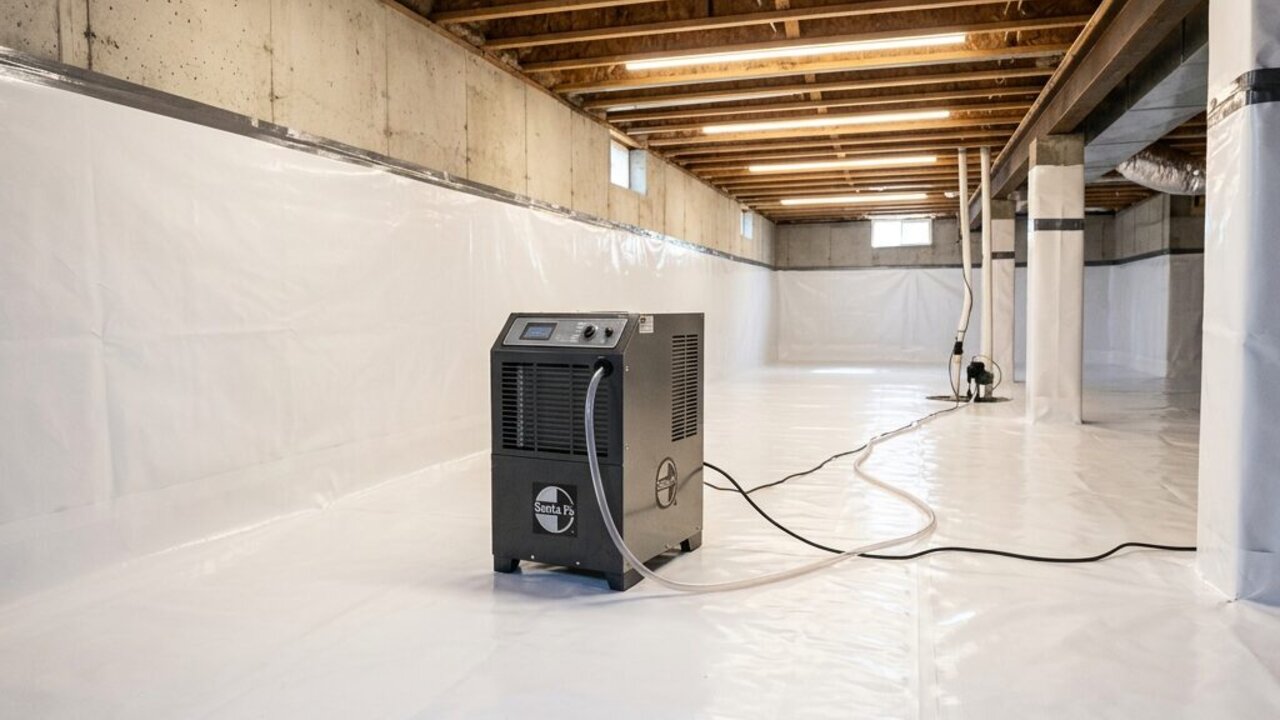
Virginia’s humid summers can keep a crawl space damp even when no active leak is visible. A dehumidifier may be part of the solution, but its value depends on the enclosure, ground moisture, drainage, electrical setup, and maintenance plan.
The practical question is not whether every crawl space needs equipment. It is whether measured humidity is being caused by conditions that a correctly sized and installed dehumidifier can actually manage.
What a Dehumidifier Does
A crawl-space dehumidifier removes moisture from the air and collects or drains the condensate. It can support a sealed or encapsulated space when the equipment is sized for the volume and the discharge path is properly planned.
It does not remove water entering through a foundation, repair a plumbing leak, replace a ground vapor barrier, or dry saturated framing by itself. Those conditions must be evaluated separately.
Check the Space Before Buying Equipment
Look for standing water, wet soil, condensation, sagging insulation, open vents, gaps at the access door, and missing or damaged ground coverage. Measure relative humidity over time rather than relying on one humid afternoon reading.
Ask whether the space is intended to remain vented or become a sealed assembly, and how the proposal handles walls, piers, access, air sealing, and the ground liner. The equipment choice follows that design.
Keep Equipment, Drainage, and Electrical Scopes Clear
A drain line needs a suitable route and termination. Electrical supply, outlet requirements, condensate protection, and service access should be reviewed by qualified professionals and included only when the provider is equipped for that work.
Drainage or waterproofing, plumbing, structural repairs, and electrical modifications are not automatically part of an insulation or humidity-control estimate. A written proposal should name exclusions and trade responsibilities.
Evaluate Value Without an Invented ROI
There is no reliable universal payback period for a crawl-space dehumidifier. Runtime, electricity rates, equipment life, maintenance, enclosure quality, and the starting moisture load vary by home.
Compare the total installed scope, operating and filter needs, warranty, noise, service access, condensate plan, and humidity monitoring. A recommendation should explain what condition the equipment addresses and how success will be checked.
Plan the Next Step
Get the crawl-space conditions documented with a free estimate, then review Virginia Beach crawl-space encapsulation information.
Frequently Asked Questions
Is a crawl-space dehumidifier worth it in Virginia?
It can be useful when a suitable crawl-space enclosure and moisture plan are in place, but it is not the right standalone answer for every home. Humidity, water entry, drainage, and construction should be evaluated first.
Can a dehumidifier replace encapsulation?
No. A dehumidifier controls air moisture; encapsulation or a ground vapor barrier addresses pathways and surfaces that allow moisture into the space. The needed scope depends on the crawl space.
Where does crawl-space dehumidifier water drain?
The condensate needs a properly planned drain or approved collection arrangement. The route and termination should be confirmed for the specific home and local requirements.
How much does a crawl-space dehumidifier cost?
The current pricing data lists $1,200 to $2,500 for a dehumidifier-only installation in an already encapsulated crawl space. A package that includes encapsulation is listed separately at $7,500 to $16,500; site conditions determine the applicable scope.
Will a dehumidifier stop standing water?
No. Standing water requires the source and drainage conditions to be investigated. A dehumidifier is intended for airborne moisture, not active water entry.